
A Guitarist's Guide to Decoding PRS

If you've spent years immersed in the worlds of Fender and Gibson, you've probably reached the point where you can decode a guitar listing almost instinctively.
"American Standard Strat?" Got it.
"R8 Les Paul?" Duh.
"AVII Jazzmaster?" Can see it in your mind's eye.
Then you stumble across a PRS listing.
Core Custom 24-08 Pattern Thin 85/15 TCI Gen III Trem 10-Top.
...what?
For many guitar players, PRS occupies an odd place in the guitar universe. The instruments are instantly recognizable, widely respected, and consistently praised by the people who own them, yet the catalog often feels opaque to outsiders. Model names don't seem to reveal what the guitar actually is. Specifications are described using terminology unique to PRS. Even familiar words like "Standard" carry meanings that differ from the rest of the industry.
The irony is that PRS is actually one of the most logical guitar companies on the planet.
Once you understand how Paul Reed Smith organizes his lineup, the confusion largely disappears. You'll realize that almost every model exists to fill a specific musical purpose, every suffix tells you something useful, and most of the company's proprietary language is surprisingly straightforward once it's translated into "guitar player."
Consider the following to be your passport into the PRS universe.
First Thing's First: Why PRS Feels Different
Before diving into models, it's worth understanding why PRS can feel intimidating in the first place.
Most players don't consciously study Fender or Gibson, they absorb them through osmosis.
We've spent decades hearing players talk about Telecasters, Les Pauls, SGs, Strats, Juniors, Deluxes, Customs, Specials, and Standards. We've watched heroes play them, read magazines about them, and seen countless used listings. Eventually the language becomes second nature.
PRS simply hasn't had that same century-long head start.
Founded in 1985, PRS arrived after most of the iconic electric guitar templates had already been established. Rather than copying them outright, Paul Reed Smith asked a different question:
"What would happen if we started with everything players already loved and refined every detail?"
That philosophy still defines the company today.
Instead of building a guitar because "that's how it's always been done," PRS tends to ask whether a neck carve could be more comfortable, whether a tremolo could stay in tune better, whether coil splits could sound fuller, or whether a pickup could be voiced more consistently from one guitar to the next.
Most PRS guitars sit somewhere between the classic Fender and Gibson camps rather than living entirely in one or the other. They borrow ideas from both traditions while introducing enough original thinking that they become something entirely their own. Understanding that philosophy makes the rest of the lineup much easier to appreciate.
The Three Families
Before you start to decode a PRS listing, you'll probably want to identify which production line the guitar belongs to. Everything else builds from there.
SE
The SE Series is where many players begin their journey into the PRS lineup.
Built overseas (in Indonesia, nowadays) to PRS specifications, SE instruments capture the look, feel, and personality of their American counterparts while remaining surprisingly affordable. They're not intended to be "budget knockoffs." They're genuine PRS guitars designed to deliver the same design philosophy with more cost-conscious manufacturing.
Modern SE models have earned an excellent reputation for quality, often punching well above their price point.
S2
If SE represents the gateway into the PRS lineup, S2 occupies the middle ground.
Manufactured in Maryland alongside Core instruments, S2 guitars feature American-built bodies and necks while simplifying certain appointments, finishes, and electronics to reach a lower price.
Think of S2 less as a "lesser" PRS and more as a streamlined one. The playing experience remains unmistakably PRS, but unnecessary luxuries are trimmed away.
Over the last several years, the S2 line has become increasingly attractive as many models have adopted electronics and pickups previously reserved for Core instruments, making them one of the strongest values anywhere in the PRS lineup.
Core
When players refer to a "Core PRS," they're talking about the flagship American-made instruments that built the company's reputation.
This is where you'll find premium figured maple tops, proprietary hardware, painstaking fretwork, beautifully finished necks, premium electronics, and the meticulous attention to detail that has become synonymous with PRS.
They're expensive. They're also among the most consistently built production guitars in the world. Whether that consistency justifies the premium is a personal decision, but very few people question the quality.
The PRS Custom 24: The Guitar That Started Everything
If there's one instrument that defines the entire PRS lineup, it's the PRS Custom 24.
Introduced at the 1985 NAMM Show, it wasn't just PRS's first production guitar, it was a statement. Rather than choosing between Fender and Gibson traditions, Paul Reed Smith deliberately split the difference. A carved maple top sits on a mahogany body like a Les Paul, while the double-cutaway body offers outstanding upper fret access reminiscent of a Strat.
The 25-inch scale length lands directly between Gibson's 24.75-inch scale and Fender's 25.5-inch scale.Twenty-four frets extend the range beyond what most vintage-inspired guitars offered at the time. The proprietary PRS tremolo provides expressive vibrato while earning a reputation for remarkable tuning stability.
In many ways, the Custom 24 is the distilled essence of the PRS philosophy: familiar ingredients assembled into something distinctly original.
Tonally, it refuses to live in just one camp. It has enough warmth and sustain to satisfy players accustomed to Gibson-style instruments while retaining enough snap and clarity to appeal to those raised on Fender guitars.
That's precisely why it has remained the flagship of the PRS lineup for four decades.
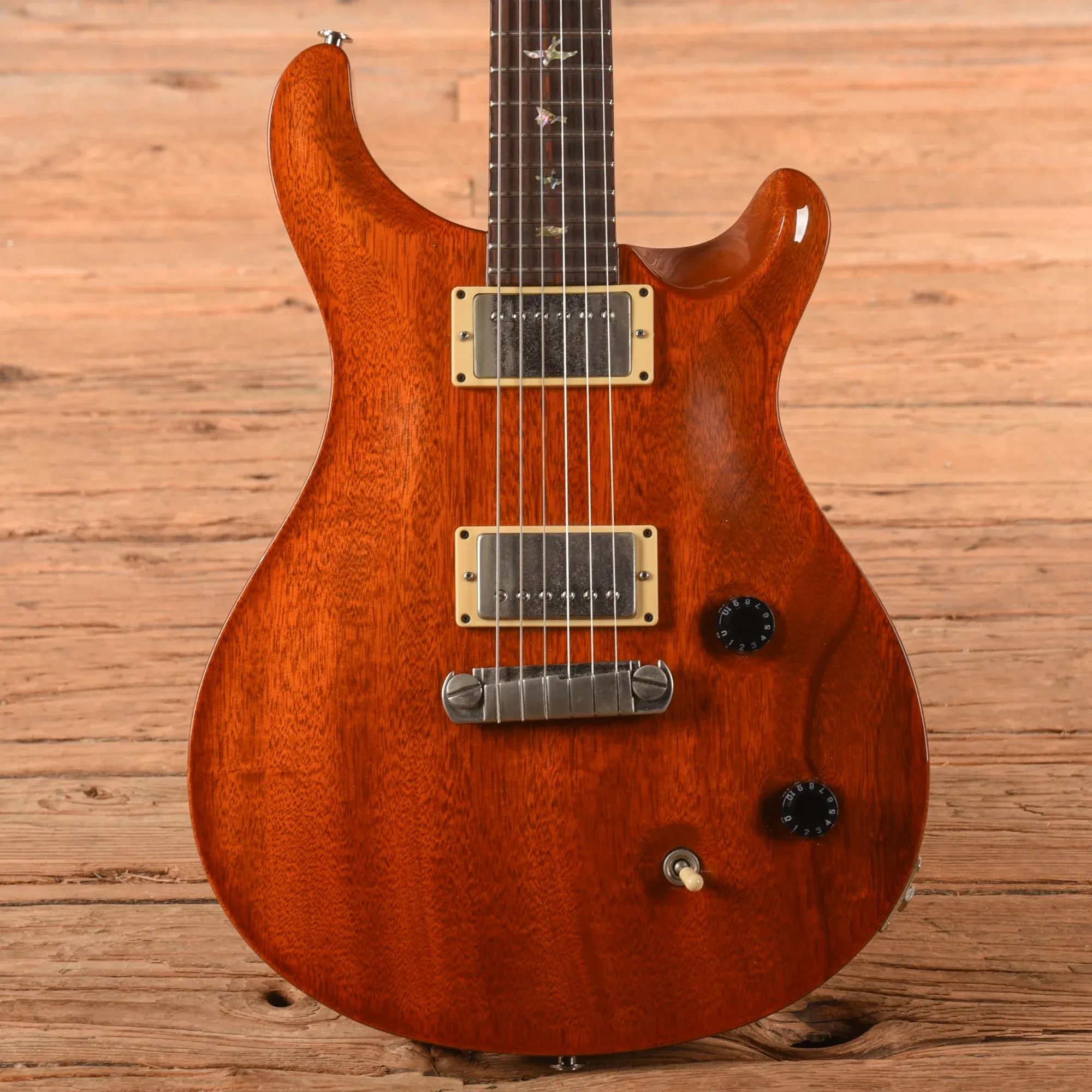
Custom 24-08
The first PRS suffix many newcomers encounter is "24-08."
Fortunately, it's one of the easiest to understand. The "24" still refers to the guitar itself. The "08" refers to eight available pickup combinations.
Traditional Custom 24 models rely on a blade selector and coil split to access different sounds. The 24-08 instead uses two miniature toggle switches that independently split each humbucker.
The result isn't simply "more sounds," it's more useful sounds.
Players gain access to convincing single-coil-inspired tones without sacrificing the intuitive control layout that makes the Custom 24 such a flexible working instrument. For players who regularly jump between genres during a set, the 24-08 has become one of the most compelling versions of the Custom 24.
PRS-Friendly
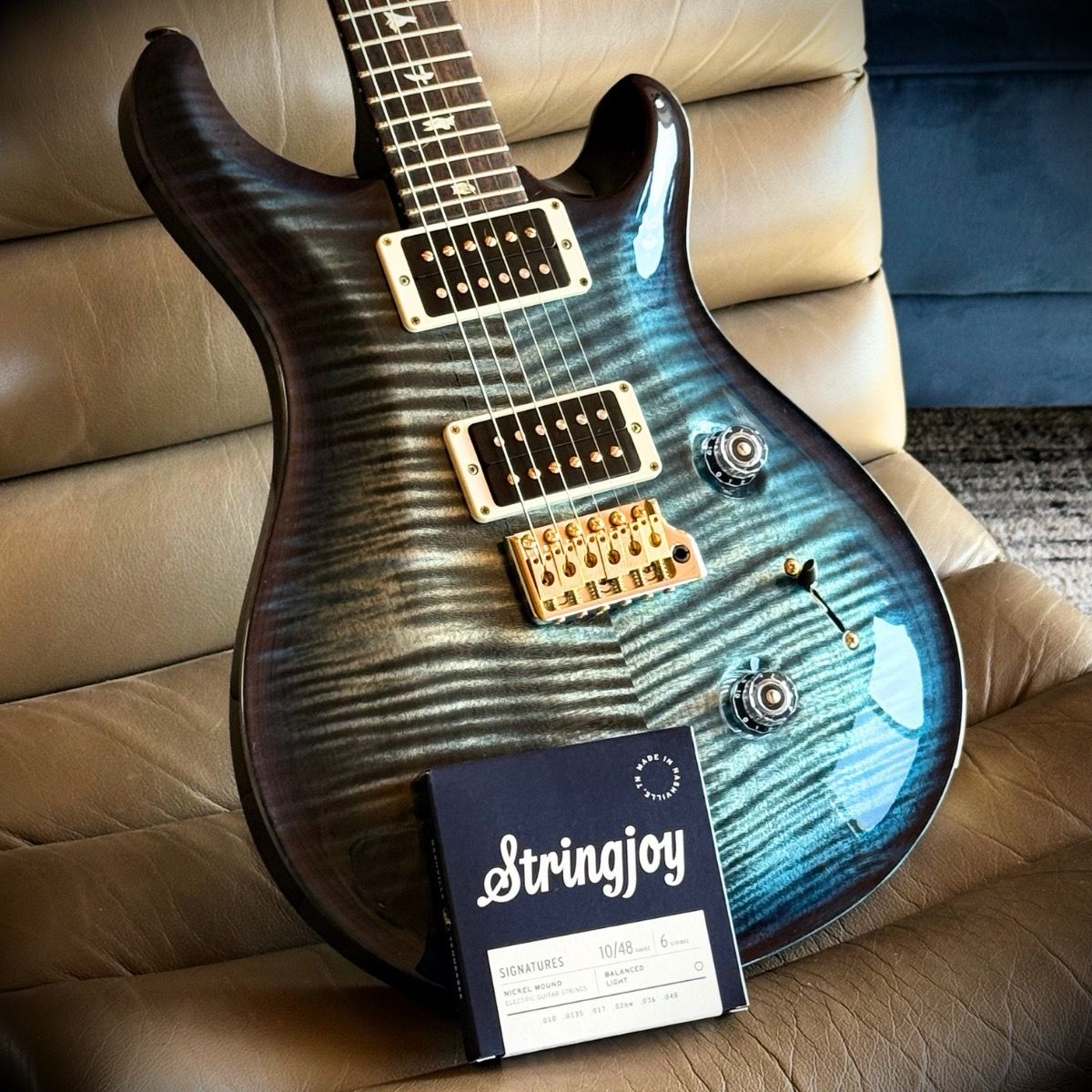
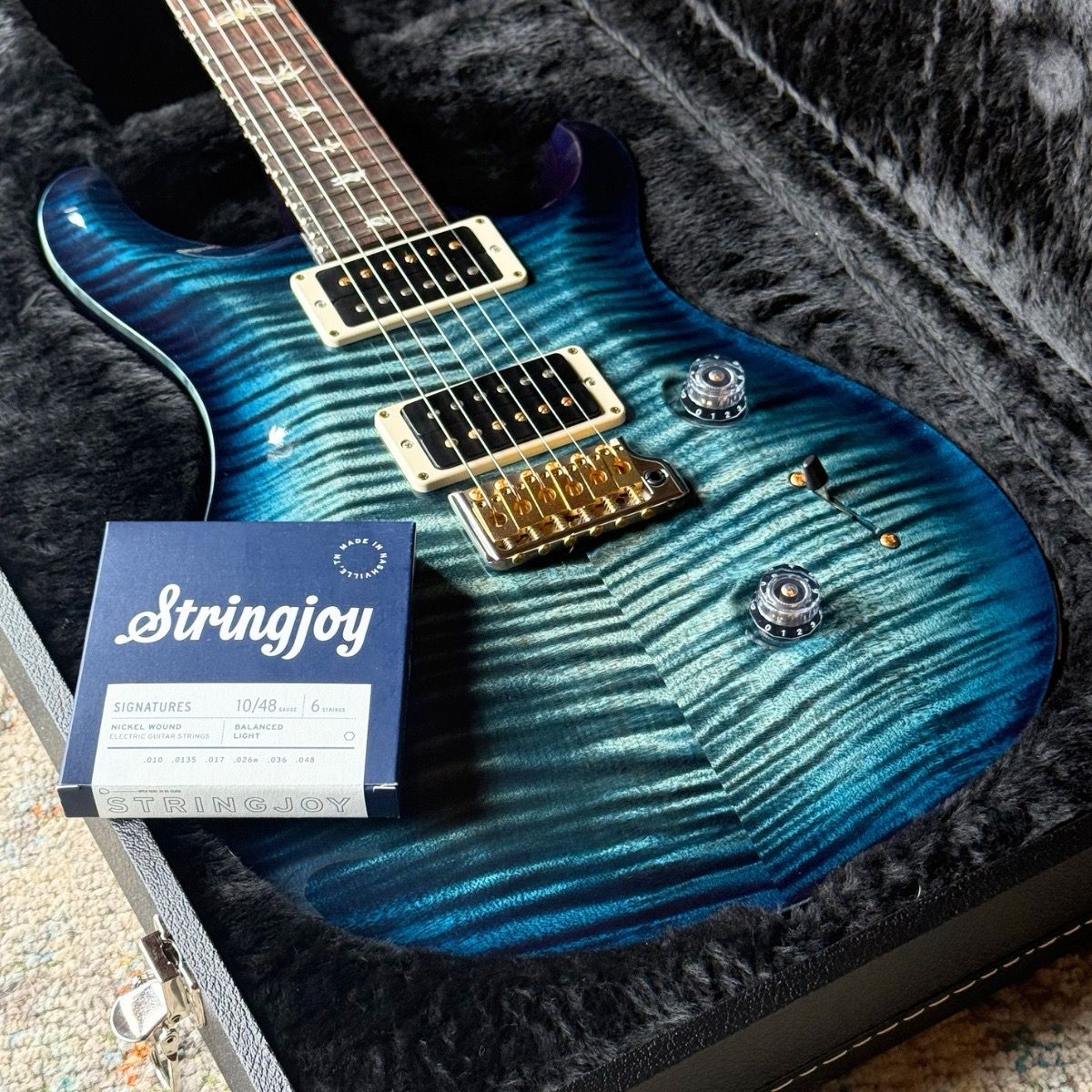
Stringjoy sets that'll bring out any PRS' best

Stringjoy 10-48 Balanced Light Gauge Signatures - Nickel Wound Electric Guitar Strings

Stringjoy 9.5-46 Balanced Super Light Plus Gauge Orbiters - Coated Nickel Electric Guitar Strings

Stringjoy 9-42 Balanced Super Light Gauge Orbiters - Coated Nickel Electric Guitar Strings

Stringjoy 9.5-48 Husky Super Light Plus Gauge Signatures - Nickel Wound Electric Guitar Strings

Stringjoy 11-48 Classic Medium Gauge Broadways - Pure Nickel Electric Guitar Strings

Stringjoy 10-46 Classic Light Gauge Broadways - Pure Nickel Electric Guitar Strings
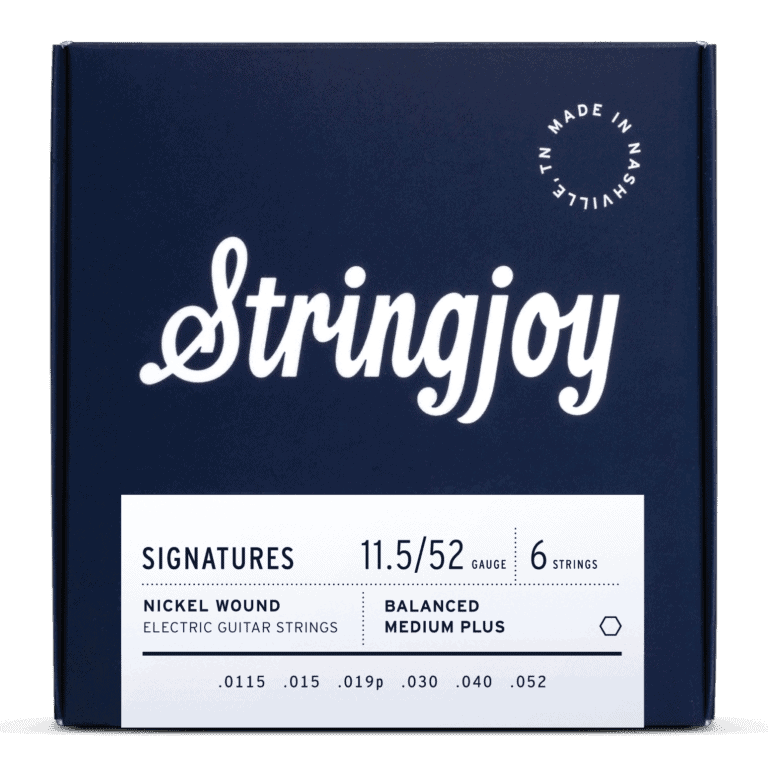
Stringjoy 11.5-52 Balanced Medium Plus Gauge Signatures - Nickel Wound Electric Guitar Strings

Stringjoy 11-50 Balanced Medium Gauge Orbiters - Coated Nickel Electric Guitar Strings
CE 24
One of the biggest surprises in the PRS lineup is the CE 24. At first glance, it looks almost identical to the Core Custom 24.
The difference lies where the neck meets the body. Where the Custom 24 uses a traditional set neck, the CE employs a bolt-on maple neck.
That single construction change dramatically alters the guitar's personality.
The attack becomes a little quicker, and note separation becomes slightly more immediate. Meanwhile, the overall feel becomes instantly familiar to players who have spent years behind Stratocasters or Telecasters.
The CE isn't better than a Custom 24, nor is it worse. It's simply aimed at players who love the PRS platform but prefer the response and feel of a bolt-on guitar.
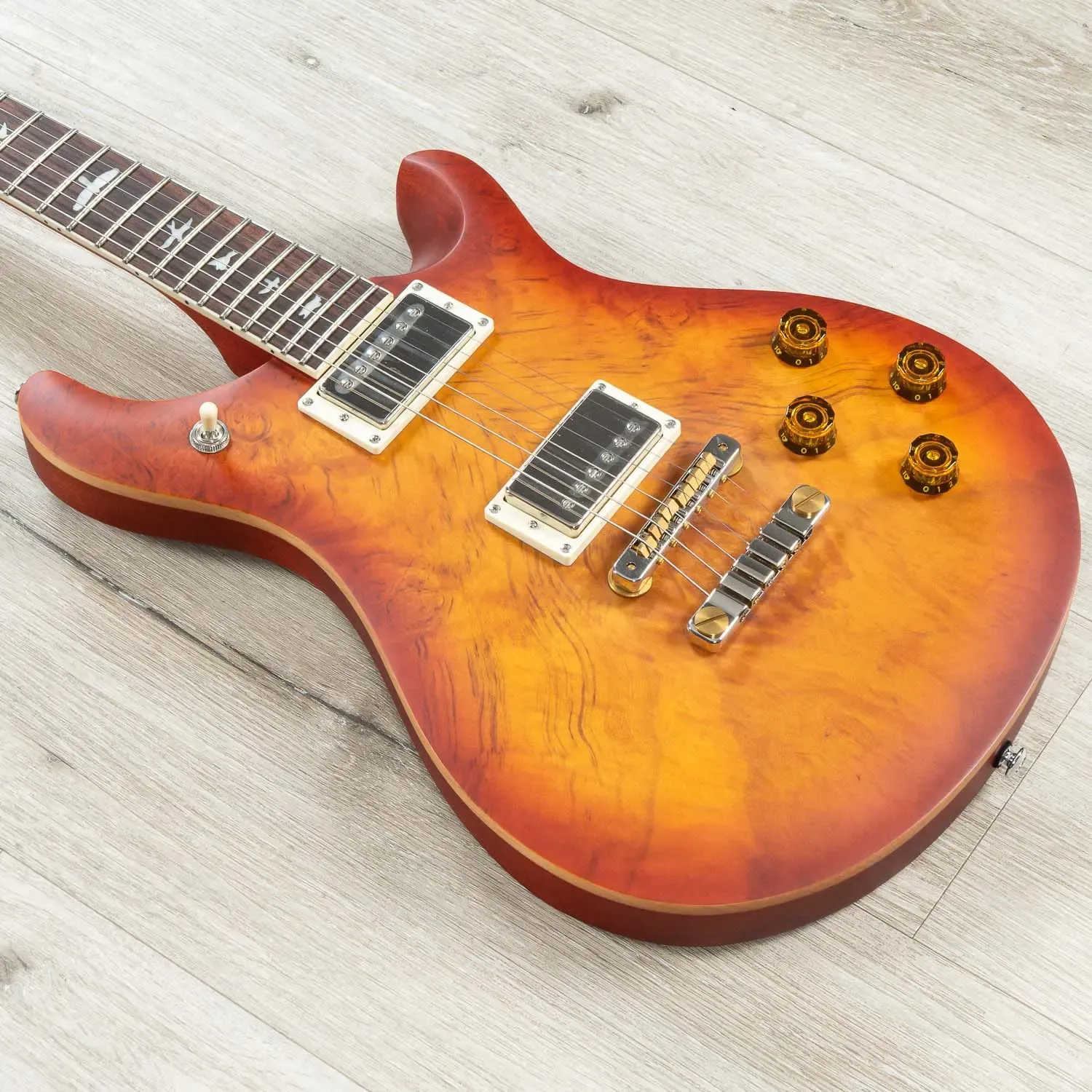
McCarty 594: Vintage Vibes, PRS Style
If the Custom 24 represents PRS at its most modern, the McCarty 594 is PRS looking backward, not to recreate history, but to improve upon it.
Named after Ted McCarty, the legendary former Gibson president who became one of Paul Reed Smith's mentors, the 594 pays tribute to the golden age of electric guitar design while quietly updating nearly every important detail.
The number itself isn't marketing fluff, either. "594" refers to the guitar's 24.594-inch scale length, a subtle nod to many beloved late-'50s instruments. It's only a fraction of an inch shorter than Gibson's traditional 24.75-inch scale, but that tiny difference contributes to the model's unique feel.
The McCarty 594 is designed for players who appreciate vintage dynamics more than modern versatility.
Compared to a Custom 24, you'll typically find:
• Two volume controls
• Two tone controls
• Push-pull coil splits
• Slightly thicker neck profiles
• Vintage-inspired bridge and tailpiece
• Lower-output pickups
The result is a guitar that responds beautifully to your hands. Roll the volume back and it cleans up naturally. Dig in with your pick and it rewards you with a broad, dynamic range rather than immediately jumping into compression.
It's an instrument that encourages interaction.
McCarty 594 Singlecut
The Singlecut version is exactly what the name suggests.
Its body shape recalls the classic single-cutaway formula, but PRS tweaks the ergonomics with more comfortable contours, a sculpted heel, and refined upper-fret access.
Players coming from Les Pauls often gravitate here first because the silhouette feels familiar, but they'll quickly notice that the neck joint, balance, and overall ergonomics are unmistakably PRS.
Tonally, the difference between Singlecut and Double Cut is subtle. Ergonomically, however, many players have a strong preference one way or the other.
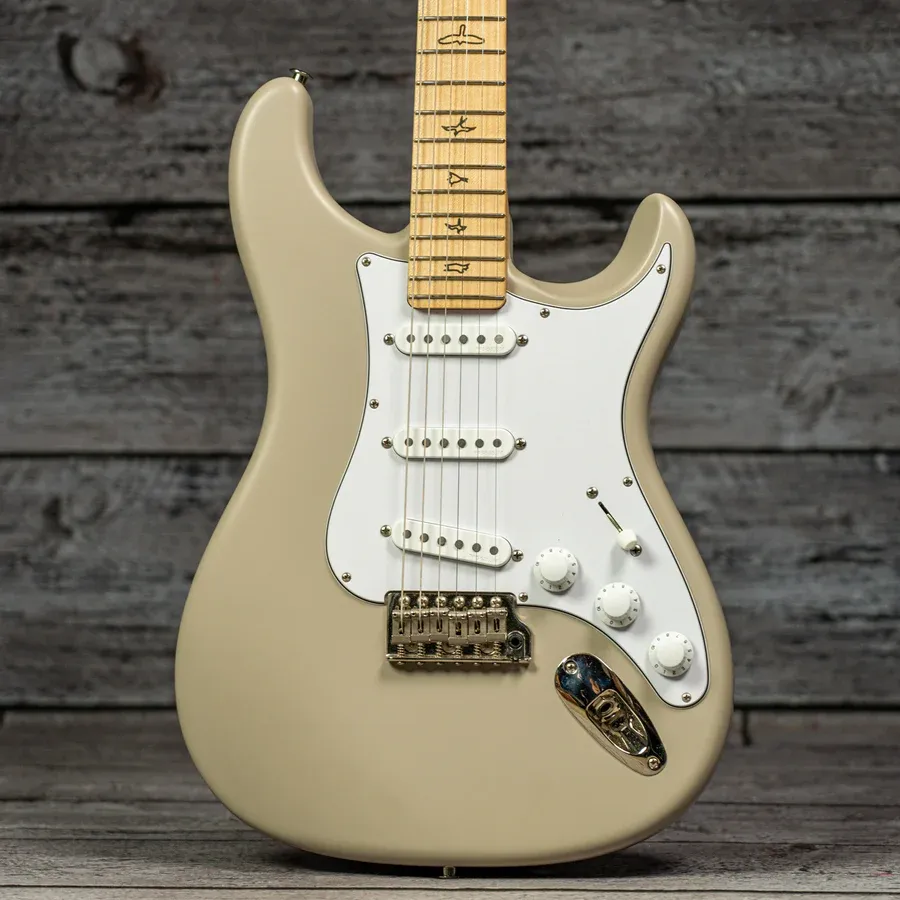
Silver Sky: More Than "The John Mayer Guitar"
Nowadays, the Silver Sky probably needs the least introduction. It's become one of the most recognizable PRS models ever built.
Designed alongside John Mayer, the Silver Sky was never intended to copy one specific vintage Stratocaster. Instead, Mayer and PRS identified their favorite characteristics from numerous vintage examples and combined them into one cohesive instrument.
That means you'll find familiar ingredients:
• 25.5-inch scale
• Three single coils
• Vintage-style tremolo
• Three-knob control layout
• Five-way switching
But almost every measurement was reconsidered. The body contours are subtly revised, the neck carve feels distinctly PRS, and the headstock is an inverted version of the standard PRS headstock, helping to improve string pull across the nut.
Another unique feature of the Silver Sky is its pickups. Instead of three distinctively voiced pickups, all three are exactly the same. That means the tonal differences they provide are solely tied to their placement along the travel of the strings. The result is an inspiring degree of balance and nuance.
Available in both Core and SE versions, the Silver Sky has become one of the company's biggest commercial successes and an easy recommendation for players who traditionally live in Fender territory but are curious about the broader PRS lineup.
DGT: The Artist Signature for Players Who Hate Artist Signatures
Some signature guitars feel like collector's pieces. The DGT ain't one of them.
Legendary hired gun David Grissom spent decades refining his ideal instrument alongside Paul Reed Smith, and the resulting guitar reflects thousands of hours of professional touring and recording experience.
Nearly every detail serves a practical purpose.The frets are slightly taller than those found on most PRS models, making bends effortless. The neck carve feels substantial without becoming cumbersome. Dedicated DGT pickups strike a beautiful balance between vintage warmth and modern articulation.
Independent volume controls allow players to blend pickups with surprising precision. Push-pull coil splits dramatically expand the tonal palette.
Many longtime PRS enthusiasts consider the DGT one of the most versatile guitars the company has ever produced. It comfortably covers blues, country, rock, jazz, Americana, and nearly everything in between. That's why you'll often hear experienced owners describe the DGT as a "desert island guitar."
Paul's Guitar
If one instrument best represents Paul Reed Smith's own personal design philosophy, it's Paul's Guitar.
Rather than chasing vintage correctness, Paul's Guitar showcases ideas Paul believed genuinely improved the electric guitar. Most notably, it introduced TCI pickups.
TCI stands for Tuned Capacitance and Inductance, a process PRS developed to fine-tune pickup performance for greater consistency and musicality.
Equally important are the narrow-field coil taps. Traditional coil splits often sound noticeably thinner than full humbuckers, and Paul wanted something better.
Instead of simply shutting off half the pickup, PRS engineered a system that preserves considerably more body and output, resulting in split sounds that remain genuinely useful rather than feeling like an emergency backup option.
Many of the ideas first explored on Paul's Guitar have gradually spread throughout the broader PRS lineup.
NF 53
At first glance, the NF 53 appears to occupy familiar territory.
Bolt-on neck, slab body, vintage-inspired bridge. Hmmm.
But like nearly everything PRS builds, the similarities with "T-Style" only go so far.
The defining feature is the Narrowfield pickup. Unlike a traditional single coil, Narrowfields use a humbucking architecture while sensing a much narrower portion of the string. The result is impressive clarity and note separation with dramatically reduced hum.
It's not a Strat, nor is it a Tele, nor is it a traditional humbucker guitar. Instead, the NF 53 occupies its own lane, appealing to players who appreciate vintage-inspired bolt-on instruments but want something unmistakably modern.
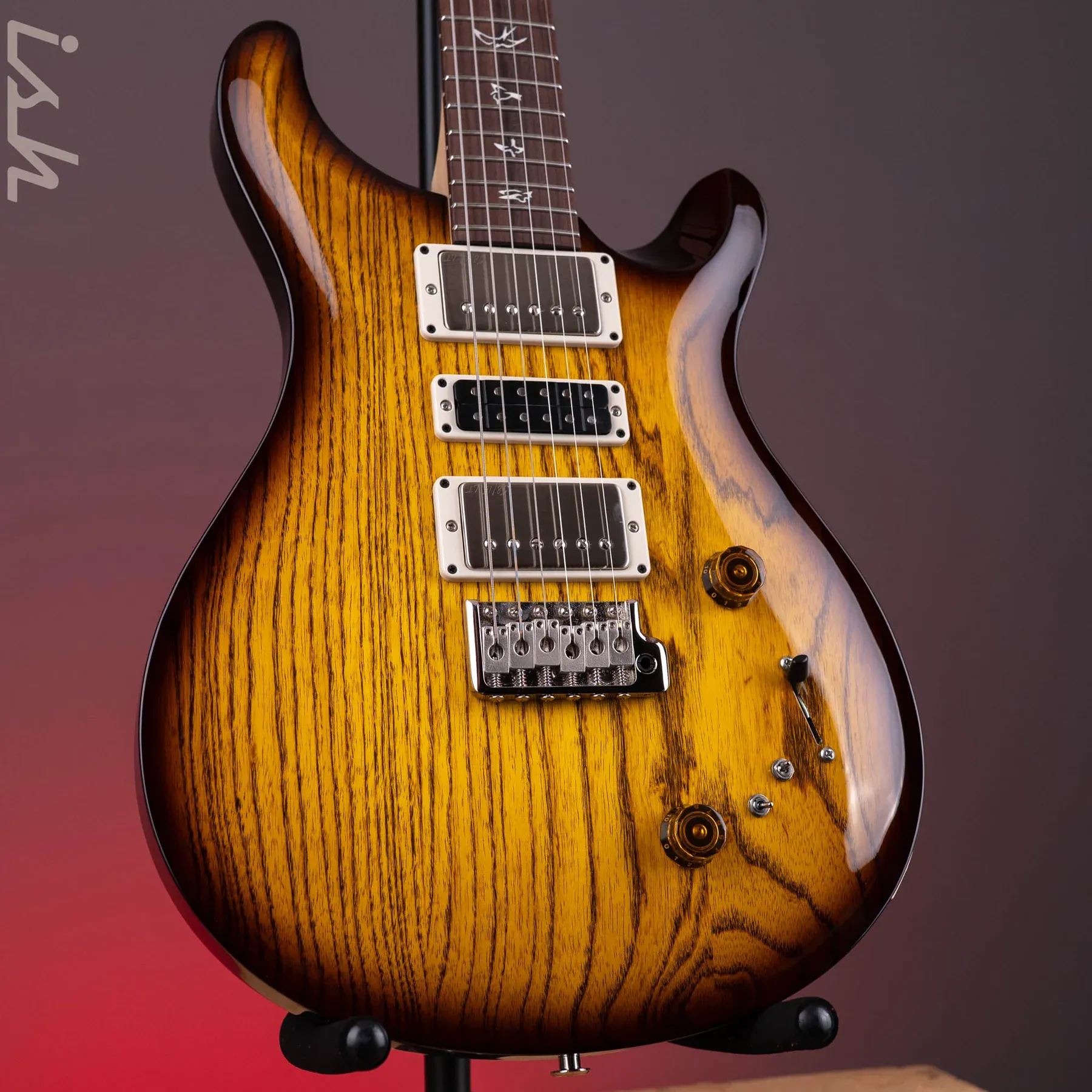
Swamp Ash Special
If versatility is your goal, don't overlook the Swamp Ash Special. Originally introduced years ago before eventually returning to the PRS lineup, it has quietly developed a devoted following.
The most obvious change is right there in the name.
Instead of PRS' standard mahogany, the body is made of swamp ash. That substitution brings additional snap, liveliness, and upper-mid clarity.
Many versions pair two humbuckers with a Narrowfield middle pickup and five-way switching, creating one of the widest tonal palettes anywhere in the PRS catalog. Players can move comfortably from sparkling clean rhythms to muscular overdriven lead tones without ever feeling like they're forcing the guitar outside its comfort zone.
Like many PRS models, the Swamp Ash Special isn't trying to replace another guitar, it's attempting to eliminate the need for several.
Understanding PRS Neck Carves
Neck profiles might be the single most overlooked specification in online guitar listings across all brands.
PRS takes them seriously, and, fortunately, the company's naming system is refreshingly logical.
Pattern Thin
Fast without feeling flat. Pattern Thin is often the first choice for players coming from modern super-Strats or other performance-oriented guitars.
Despite the name, it isn't paper-thin. It simply offers a slimmer shoulder and faster feel.
Pattern
If you only play one PRS neck profile, it'll probably be Pattern. Think of it as the company's "Goldilocks" carve. Not too thin, not too chunky. Comfy for almost everyone. Many Core PRS models feature Pattern necks because they appeal to the broadest range of players.
Pattern Vintage
Pattern Vintage increases shoulder and overall fullness while maintaining comfortable ergonomics. Players accustomed to substantial late-'50s necks often feel immediately at home here, and it's particularly common within the McCarty family.
Pattern Regular
Pattern Regular traces its roots back to Paul Reed Smith's original neck dimensions. Although newer Pattern profiles have become more common, Pattern Regular remains a favorite among longtime PRS enthusiasts and appears frequently on used listings.
Understanding PRS Pickups
Spend enough time browsing PRS listings and you'll inevitably encounter pickup names that sound more like engineering projects than guitar components.
Good news is, they're much easier to understand than they first appear.
85/15
If you've been looking at a PRS Custom 24, you've almost certainly seen the 85/15 name.
PRS made its debut in 1985, and these humbuckers were released in the company's 30th anniversary year, 2015. Simple, right?
85/15s are among the company's most balanced modern designs. They're articulate without sounding sterile, powerful without becoming overly compressed, and exceptionally responsive to picking dynamics. Think of them as "modern" pickups—not because they're aggressive, but because they emphasize clarity across the entire frequency range. That's one reason the 85/15 remains such a natural fit for the PRS Custom 24.
58/15 LT
58 refers to the vintage inspiration behind these pickups, and 15 once again points to their year of release. The "LT" stands for Low Turn.
With fewer winds than their standard counterparts, 58/15 LT pickups produce lower output, greater openness, and a more vintage-style response. They're commonly found in the McCarty 594 family, where they complement the guitar's dynamic, old-school personality. Instead of pushing an amplifier harder, they reward subtle changes in touch, pick attack, and volume knob adjustments.
DGT Pickups
Designed alongside David Grissom, DGT pickups occupy a sweet spot between vintage warmth and modern articulation.
They clean up beautifully with the guitar's volume controls while retaining enough authority for heavier gain settings.
Narrowfield
Few PRS innovations create more confusion than Narrowfield pickups. Despite their size, they aren't traditional single coils, nor are they conventional humbuckers.
Instead, PRS engineered a humbucking pickup with a much narrower magnetic aperture. The result is remarkable note separation and clarity while dramatically reducing the hum associated with vintage-style single coils.
Once you've played them, they make perfect sense. Until then, they're one of those uniquely "PRS" concepts that seems mysterious on paper.
TCI
As previously mentioned, TCI stands for "Tuned Capacitance and Inductance." Within the range, TCI doesn't always refer to a specific pickup model, instead pointing to PRS' calibration process.
However, some models do indeed feature "TCI Pickups," meaning they are specifically calibrated for that model, with different voicings from model to model.
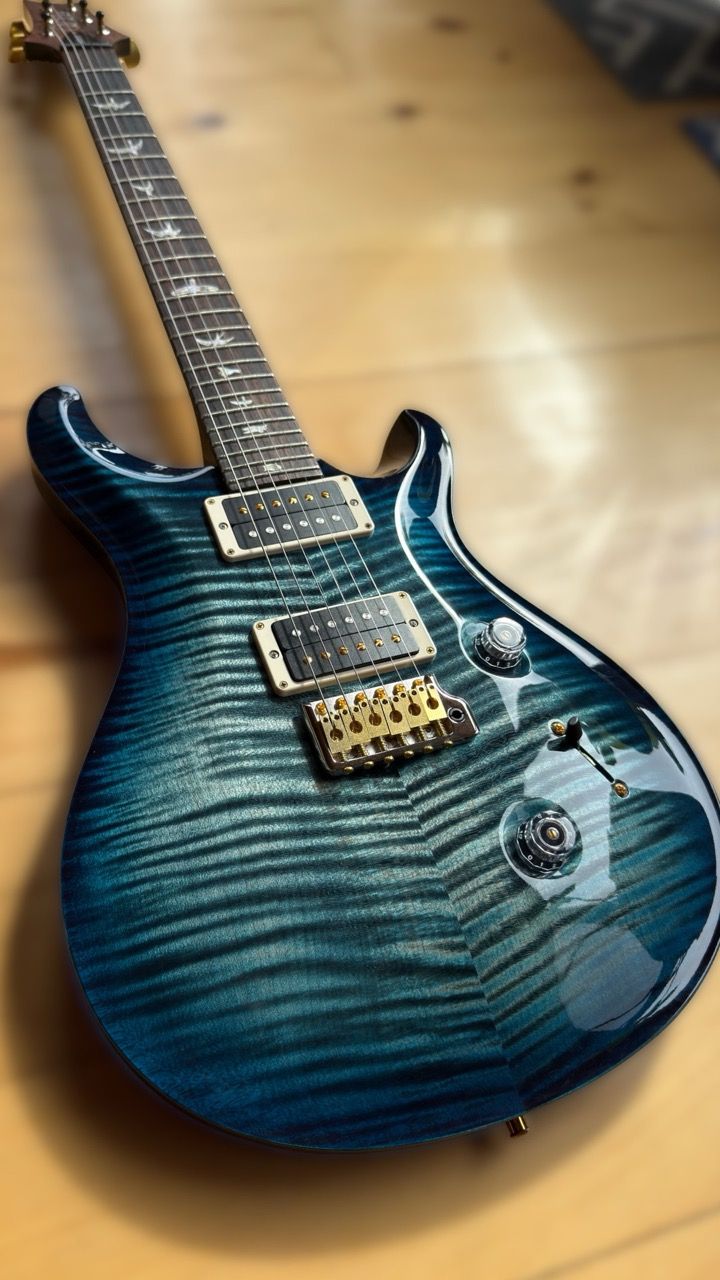
Other Handy PRS Terms
A handful of recurring features appear throughout the PRS lineup. Understanding them makes online listings dramatically easier to interpret.
The PRS Tremolo
Many players initially assume PRS's proprietary tremolo is simply another synchronized bridge. It's considerably more refined than that, and has undergone many updates over the years.
The bridge was designed around smooth operation, excellent return-to-pitch stability, and minimal friction throughout the system.
No tremolo bridge is magic, but among production guitars, the PRS tremolo has earned one of the strongest reputations in the industry for balancing expressive feel with dependable tuning stability across all three main generations of its design.
Piezo Systems
Whenever you see "Piezo" attached to a model name, it means the bridge contains piezoelectric elements capable of producing acoustic-style sounds.
Unlike digital modeling systems, piezo pickups sense string vibration directly through the bridge. Most PRS Piezo instruments allow players to send magnetic and acoustic signals to separate outputs or blend them together into one remarkably versatile instrument. For working musicians covering a wide range of material, that flexibility can eliminate an instrument change altogether.
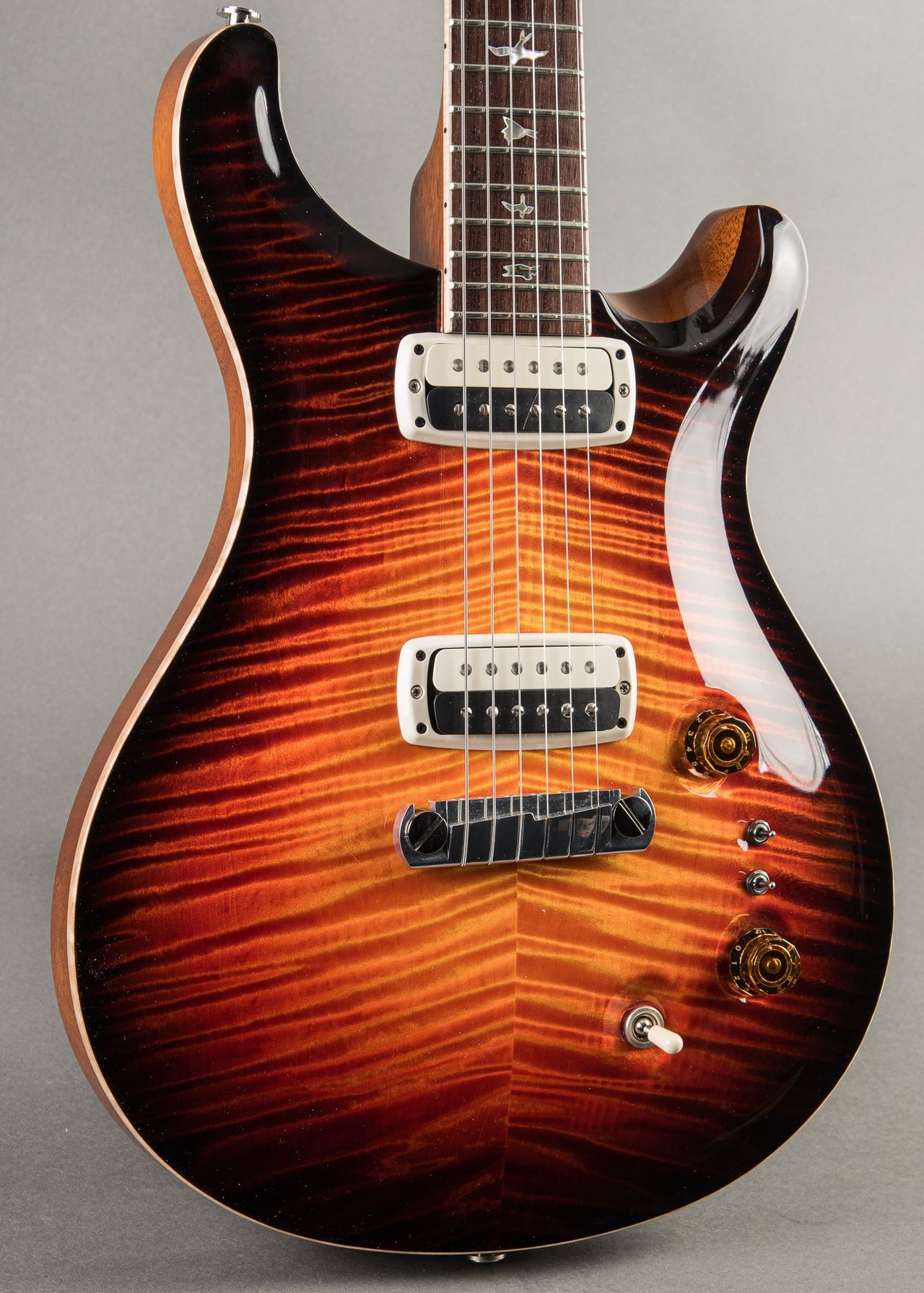
10-Top
A PRS 10-Top is a premium cosmetic grading assigned to highly figured flame or quilt maple tops.
To qualify, the maple cap must have clearly defined, three-dimensional figuring (curl) across its entire surface with no "dead spots" or blank areas. Guitars that pass the 10-Top grade are easily identified by a small, handwritten "10" on the back of the headstock in the upper right corner.
24-08 Switching
One of PRS's smartest innovations is also one of its easiest to overlook. Rather than relying on one global coil split, the 24-08 toggle switching system independently splits each humbucker, dramatically expanding the guitar's usable sounds without making the controls unnecessarily complicated.
"Standard"
Within the PRS lineup, "Standard" has nothing to do with quality, it simply indicates an all-mahogany body.
A Standard isn't a stripped-down Custom. It's simply built around a different tonal recipe.
Artist Package
Artist Package guitars occupy an interesting middle ground. They're still Core production instruments, but they receive upgraded figured woods, premium appointments, and expanded finish options selected from PRS's Artist-grade lumber inventory.
Think of them as factory-upgraded Core models rather than entirely separate instruments.
Wood Library
Wood Library guitars are built in limited batches for individual dealers using combinations of woods, neck carves, finishes, pickups, and appointments that fall outside the standard production catalog.
One dealer might commission swamp ash bodies with Brazilian rosewood fretboards. Another might request flame maple necks paired with unusual pickup combinations. Because they're dealer-specific, Wood Library instruments often become highly sought after on the used market.
Private Stock
At the very top of the PRS universe sits Private Stock. These are effectively custom-built instruments produced by PRS's most experienced builders using extraordinary woods, custom inlays, one-off finishes, and virtually unlimited personalization.
They're less a separate model line than an entirely different tier of craftsmanship. If you've ever gotten intense sticker shock when browsing PRS listings, there's a good chance you ran into a Private Stock instrument.
Let's Give it a Whirl: How to Read a PRS Listing
Once you've learned the vocabulary, PRS listings become surprisingly informative.
Imagine you come across this title:
Core Custom 24-08, Pattern Thin, 85/15 pickups, Gen III Trem, Artist Package
Without seeing a single photograph, you already know quite a bit.
- It's a flagship American-built guitar.
- It's based on the company's original model.
- It features eight pickup combinations through independent coil splitting.
- It has the slimmer neck profile.
- It uses modern, articulate humbuckers.
- It has PRS's latest tremolo system.
- And it includes upgraded cosmetic appointments through the Artist Package.
What initially looked like alphabet soup is actually a concise description of the guitar's personality. Once the terminology clicks, the catalog stops feeling confusing and starts feeling incredibly organized!
Final Thoughts
For many guitarists, PRS represents the last great frontier.
Once you've learned the difference between SE, S2, and Core, understood what separates a PRS Custom 24 from a McCarty 594, discovered why the Silver Sky, DGT, Paul's Guitar, NF 53, and Swamp Ash Special each exist, and decoded terms like 24-08, Pattern Thin, TCI, Piezo, and Standard, the entire catalog begins to reveal itself.
Perhaps the most impressive thing about the PRS lineup isn't the figured maple, the immaculate finishes, or even the legendary build quality.
It's the intentionality. Very few PRS models exist simply to fill shelf space.
Each was designed to solve a different musical problem, serve a different kind of player, or offer a different interpretation of what an electric guitar can be.
That's why so many musicians who finally venture into the PRS universe tend to stick around. Beneath the unfamiliar terminology lies one of the most thoughtfully organized, and thoughtfully engineered, lineups in the guitar world.
So, whether you're shopping your first PRS or simply trying to make sense of the listings filling your browser tabs, understanding the language is the hardest part. After that, all that's left is deciding which one you want to play first.
And which strings to pair with it =]
Other Posts you may like


Guitar Strings Order: How the Guitar is Tuned and Why

Two Handed Tapping: Our Top 8 Tappers of All Time

Which Guitar Strings Wear Your Fret Wire Down More?
What is Nashville Tuning? Its History, Best Guitar Strings & Uses

Guitar Scale Length Explained: String Tension & Playability
What Guitar Strings I Used To Play...
0 Responses
Leave a Reply
Your email address will not be published. Required fields are marked *


